How many restrooms does a golf tournament need in Miami Beach?
Start with the field size, not the course size. A 144-player field spread over 18 holes moves in waves, so clustering restrooms at high-traffic points, the turn, the driving range and spectator galleries, matters more than spacing units evenly across the whole property. OSHA 1926.51(c) sets the baseline ratio for worker sanitation at one toilet per 20 people, and tournament organizers in Miami Beach use that same math as a floor for spectators and staff, then add units for galleries at marquee holes. A standard portable restroom works for most of the course. Put ADA-accessible units near the clubhouse, the pro shop and any accessible cart path, since that is where mobility-limited spectators and players actually gather. For a multi-day member-guest or a charity scramble, a deluxe flushable unit at the 9th and 18th greens reads a lot better in photos than a standard unit does. If the tournament draws a real gallery, consider a small restroom trailer near the clubhouse instead of a bank of single units. Not sure on the count? The how many porta potties do I need guide walks through the math hole by hole, and a quote request gets you a number specific to your field size.
What restroom options fit a golf tournament?
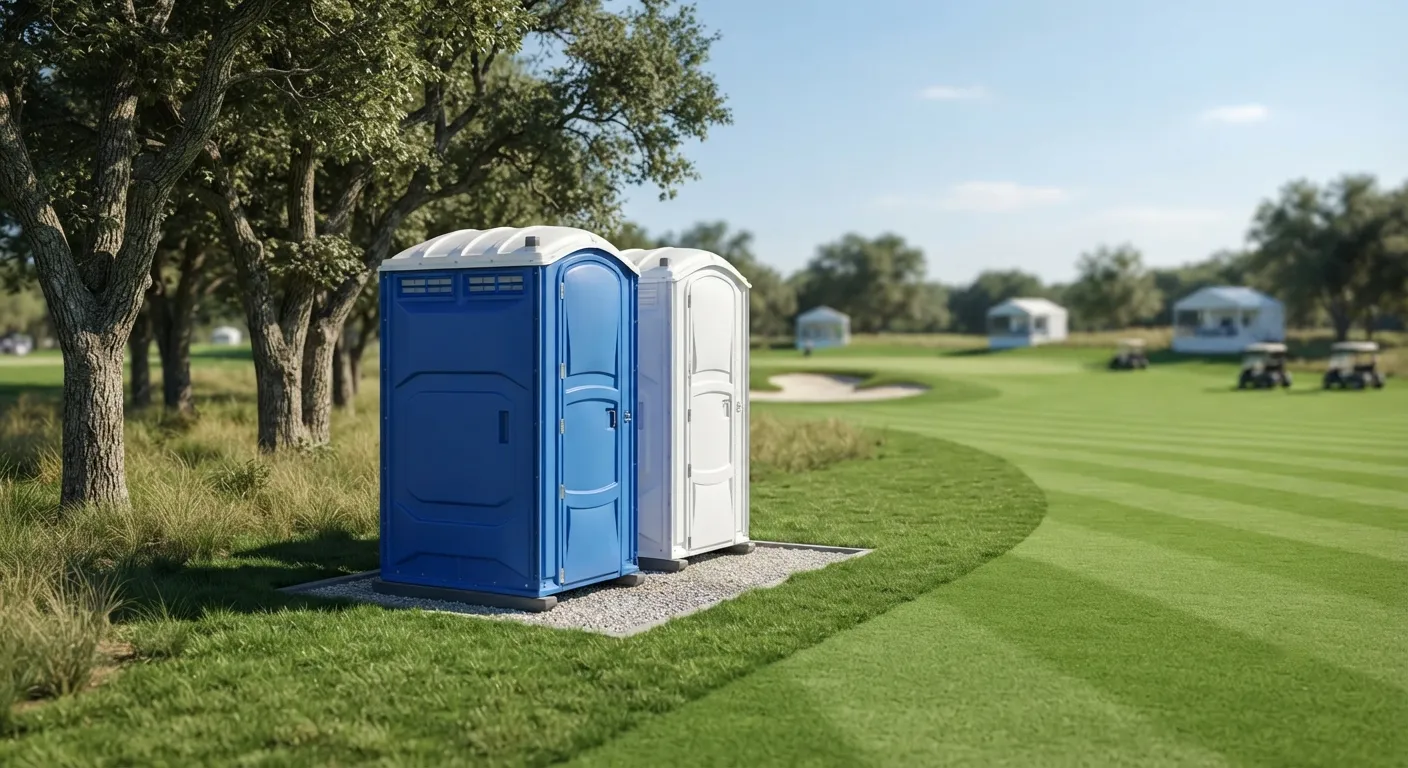
Most 18-hole tournaments in Miami Beach run a mix: standard units on the course, something nicer near the clubhouse. A standard portable toilet sits on a 44 by 48 inch footprint and stands about 92 inches tall, small enough to tuck behind a tee box or a cart barn without blocking sightlines. It carries a 60 to 70 gallon holding tank, plenty for a one-day event with the servicing schedule outlined below. For the clubhouse or awards area, a deluxe flushable model or a 2-stall restroom trailer gives players and sponsors something closer to a real bathroom, with running water and a mirror. Bigger charity events with a hospitality tent sometimes step up to a 4-stall trailer. Handwashing matters here too: 29 CFR 1910.141(d)(2) requires soap and towels or a hand-drying device at wash stations, not just sanitizer, so pair units with an actual handwashing station rather than a sanitizer stand alone if food service is part of the day. Course maintenance crews spraying fairways or greens fall under a different rule: OSHA 1926.51(f)(1) requires washing facilities where herbicides or pesticides are applied, worth flagging to the grounds crew separately from spectator sanitation.
| unit | duration | typical price |
|---|---|---|
| standard | event | $400 |
| ada | day | $230 |
| deluxe | day | $300 |
| trailer | event | $3,500 |
Prices vary by field size and course layout; see porta potty rental cost or restroom trailer rental cost for the full breakdown.
Where should units go on the course?
Placement decides whether the tournament runs smoothly or generates complaints by the 4th hole. Keep units off cart paths and out of a golfer's line of sight to the green; tuck them behind tree lines or maintenance sheds instead. Every accessible unit needs a stable, firm, slip-resistant surface underneath it, per ADA Standards section 302.1, which usually means a plywood pad over turf near cart paths. The unit itself needs a 32 inch clear door opening under ADA Standards section 404.2.3 and a 60 inch turning circle inside per ADA Standards section 304.3.1, so it cannot sit wedged against a fence or a golf cart storage rack. Placement in a public right of way, if any part of the course borders city street parking, needs confirming with Miami Beach directly; nothing in our standard placement guide covers that. For general siting logic beyond golf, the porta potty placement guide has more detail. Clubs running events near Brownsville, 6.4 miles west, or North Bay Village, 7.2 miles north, use the same placement rules since course layouts nearby follow similar cart path and green sightline constraints.
Multi-day tournaments also need a service plan. ANSI/PSAI Z4.3 sets a baseline of one service visit per week for up to 10 users over a 40 hour week, but a tournament weekend concentrates traffic into two long days, so most Miami Beach clubs schedule a mid-event service call rather than waiting for the standard interval. Our emergency porta potty rental line covers last-minute additions if the field grows after the tee sheet is set.
How far in advance should we book restrooms for a tournament?
Two to three weeks out is safe for a standard field size; four weeks if you need a restroom trailer or multiple ADA units, since trailers book up faster during peak event season. Course closures for setup also affect delivery windows, so confirm access the same week you place the order.
Do we need ADA-accessible units even if no players use wheelchairs?
Yes. ADA Standards section 213.2 requires at least one accessible unit per cluster regardless of your specific field, because spectators, caddies and staff are covered too. Skipping it risks complaints from anyone using the course that day.
Can units be placed near greens without damaging turf?
Yes, with a protective pad underneath. Delivery crews use plywood or mats to spread weight and avoid rutting, especially near the 9th and 18th where foot traffic concentrates during a tournament.
What if the tournament runs two days?
Plan for a mid-event service visit rather than relying on a single weekly cleaning. Tank capacity on a standard unit, 60 to 70 gallons, comfortably covers one long day but tightens up over back-to-back tournament rounds with a full field.
How do restrooms get delivered on a course with narrow cart paths?
Delivery trucks need clear access, similar to the 60 feet of straight clearance a roll-off truck needs on job sites. Walk the route with our team before event day so we can flag any gate, bridge or tight turn on the course.
Next step
Get a delivery date
Tell us the address, the dates and the headcount. We size the order and confirm the route.