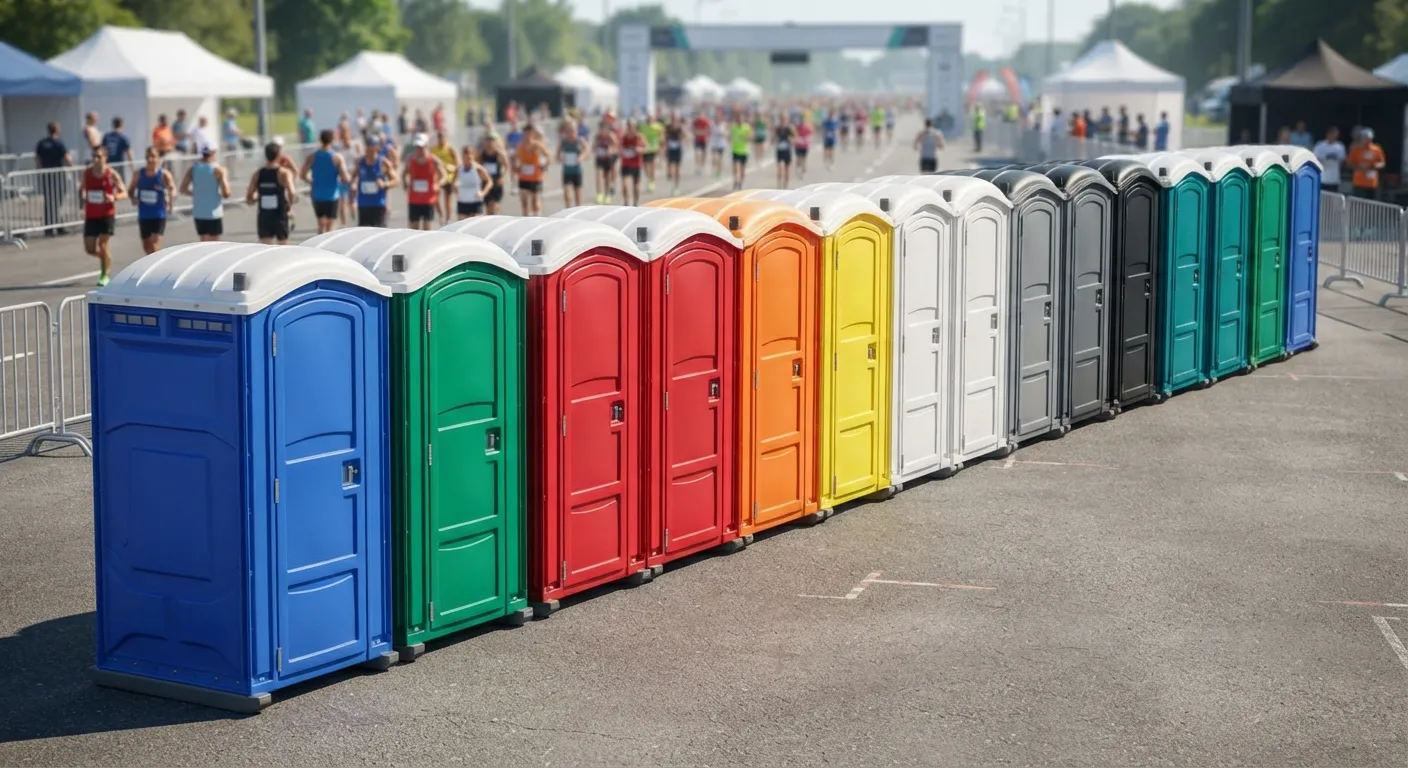
How many restrooms does a race need?
Runner count drives everything, but so does course layout. A point-to-point marathon spreads people out along construction site services-grade equipment placed at aid stations, while a looped 5K can cluster units near the start/finish. OSHA 1926.51(c) sets ratios for construction crews, not spectators, but race directors use it as a starting benchmark: roughly one toilet per 20 to 40 people for a working shift. For a race, that ratio needs padding since everyone needs the restroom in the same 20-minute window before the gun goes off, not spread across an 8-hour shift. A standard unit rents for a single day within the 100 to 350 dollar range typical for this market, and most races book several. Larger events add an ADA accessible porta potty or two to meet ADA Standards 213.2, which requires at least 5 percent of clustered single-user units be accessible, never fewer than one. Check the porta potty placement guide before finalizing your map, because sight lines to the course and firm, level ground per ADA Standards 302.1 both matter. A portable restroom rental plan built around checkpoints, not just the finish line, keeps lines short.
Race weekends in Miami Beach also mean road closures and generator-powered timing mats near the finish. If your event runs a temporary power pole for timing equipment or a sound system, brace it properly: guy it at three points spaced evenly around the pole, anchor each line to a stake or ballast block set well clear of the runner corridor, and keep the base pad on flat ground so wind off the water does not walk it over mid-race. A loose pole near a finish chute is a hazard nobody wants to explain afterward. Knowing how to brace a temporary power pole properly before the crowds arrive is worth the extra ten minutes it takes on setup morning.
What does restroom rental cost for a race?
Race budgets usually separate restroom cost from delivery and service fees, so read the quote line by line before you sign anything.
| item | duration | typical cost |
|---|---|---|
| standard unit | event | 400 |
| ADA unit | day | 230 |
| delivery fee | day | 150 |
| service fee | day | 175 |
Event-day pricing for a standard unit runs higher than a single weekday rental because race organizers need units delivered, serviced, and pulled within a tight window, often before dawn and right after the last finisher clears the chute. Check porta potty rental cost and porta potty rental per day for how daily and weekly rates compare if your event runs a multi-day expo alongside the race. A deluxe flushable porta potty near the VIP or sponsor tent costs more than a standard unit but handles higher traffic without odor buildup mid-event. If your race includes a beer garden or post-race party, a restroom trailer rental gives guests real sinks and mirrors, and a 4 stall restroom trailer handles a finish-line crowd better than a bank of single units. For multi-day festivals tied to the race weekend, look at festival restroom rental planning separately from race-day counts.
Where should units go along the course?
Placement beats raw count almost every time. Cluster units at the start corral, at each aid station past mile 3, and in force at the finish festival where runners linger for food and photos. Miami Beach courses that run along the waterfront need units set back from soft sand or landscaped medians onto stable, firm ground, consistent with ADA Standards 302.1 for anyone using a wheelchair or stroller. Leave a 36 inch clear path per ADA Standards 403.5.1 to each unit, especially where barricades line the route under OSHA 1926.202 guidance for crowd control structures. If your race route crosses into neighboring areas, note that Brownsville sits 6.4 miles west and Miami Shores 6.8 miles northwest of Miami Beach, both relevant if your course or shuttle logistics extend that far. Coordinate delivery trucks needing roughly 60 feet of straight clearance behind them, since a loaded service truck cannot maneuver in a tight finish-line footprint the way a delivery van can. For hand hygiene near food vendors, add a handwashing station rental or two, since 29 CFR 1910.141(d)(2) requires soap and towels or a drying device at wash stations, not sanitizer alone. Review the how many porta potties do I need guide for a fuller breakdown by attendance tier, and the emergency porta potty rental option if your runner count jumps late.
How far in advance should we book race restrooms?
Book 4 to 6 weeks out for anything over 500 runners. Race weekends compete with weddings and festivals for the same equipment fleet, and Miami Beach fills up fast on peak-season Saturdays. Confirm your request a quote early to lock delivery windows.
Do we need ADA units for a race?
Yes, if you have any public spectators or para-athletes on course. ADA Standards 213.2 requires at least one accessible unit per cluster, 5 percent minimum. See ADA restroom requirements for full spec details including door and turning-space clearances.
Can we get units removed same day after the race?
Same-day pickup is common for race events, though it depends on crew scheduling. Build pickup timing into your contract, and ask about the emergency septic service option if a unit needs mid-race pumping.
What permits does a race restroom setup need?
Placement in public right-of-way needs confirming with the City of Miami Beach directly; rules vary by course and street closure plan. Start with the porta potty permit requirements page and confirm specifics before finalizing your map.
Should aid stations have their own restrooms?
Yes, for races over 10K. Runners will not backtrack to the start for a bathroom. Space units at aid stations past mile 3, and check the porta potty rental checklist for a full pre-race setup list.
Next step
Get a delivery date
Tell us the address, the dates and the headcount. We size the order and confirm the route.